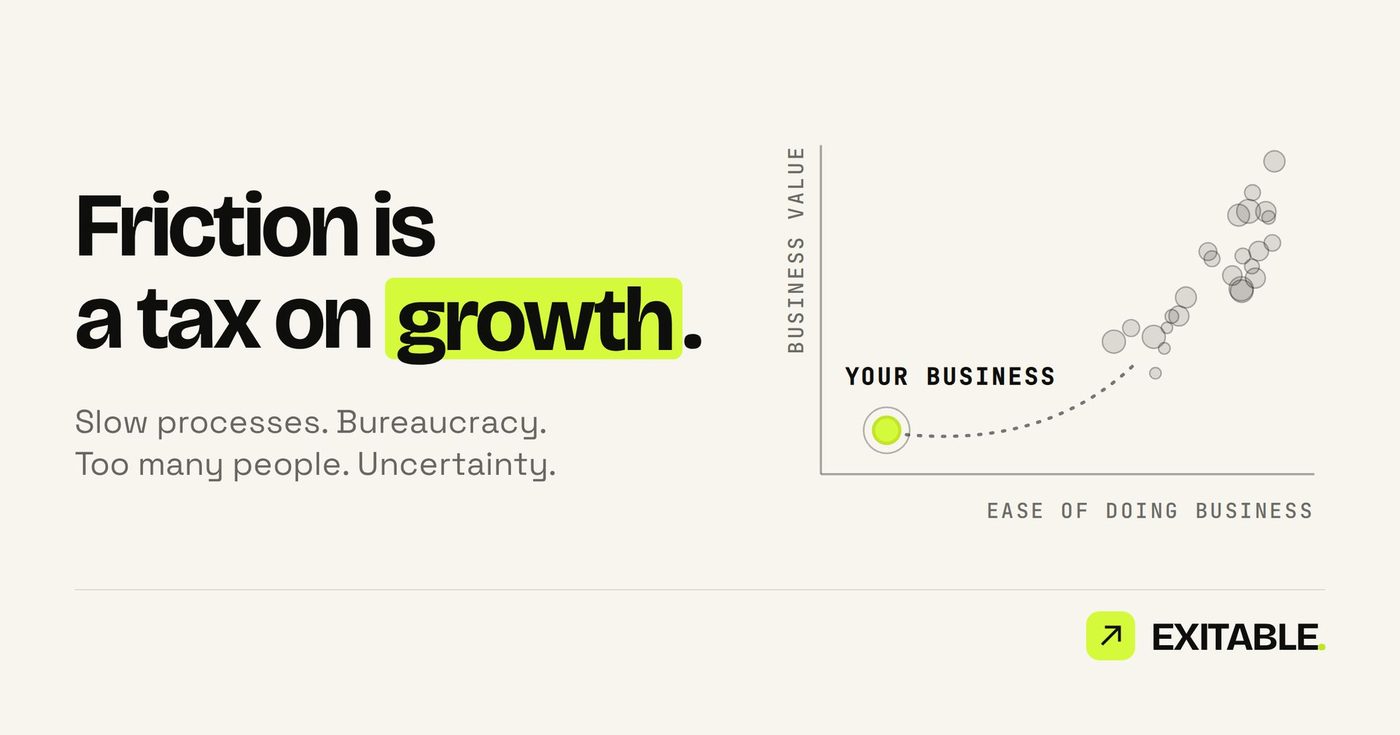
Plot the world's economies on a chart, comparing how easy it is to do business in each country with how wealthy it is.
I’ve been looking at some of the data this week and there’s certainly a correlation.
It's hardly surprising that the easier it is to start and run a business somewhere, the wealthier that place tends to be, as measured by GDP per capita.
Make it hard, with slow approvals, layers of bureaucracy and rules nobody can predict, and growth stalls.
But it doesn't just apply to countries. It applies to businesses too.
Your business is its own economy. And you decide how easy it is to get things done in it.
Here's the part that's easy to miss. The places doing best aren't places without rules. Many of them have plenty.
What sets them apart is that doing business there is easy: things happen quickly, there are few hoops to jump through, and everyone knows where they stand.
Ease of doing business isn't the absence of rules. It's the absence of friction.
Friction comes in more forms than red tape. Slow processes. Paperwork and bureaucracy. Too many people involved in simple decisions. And uncertainty, where nobody is quite sure who decides or what's expected.
None of these things stops anything outright. Each one just makes things a little slower, a little harder and a little less worth the effort. Friction doesn't kill ambition. It makes acting on it not worth the trouble, and across millions of small decisions, that adds up to a poorer economy.
Now run the same test on your business
Forget how many rules you have for a moment. Ask how easy it is for your people to get things done.
- Speed. How long does it take to get a quote out, a hire approved or a problem fixed?
- Steps. How many forms, approvals and hand-offs does a simple job go through?
- People. How many people need to be involved before anything moves?
- Clarity. Does everyone know who decides, what good looks like and what matters most? Or do they wait and ask?
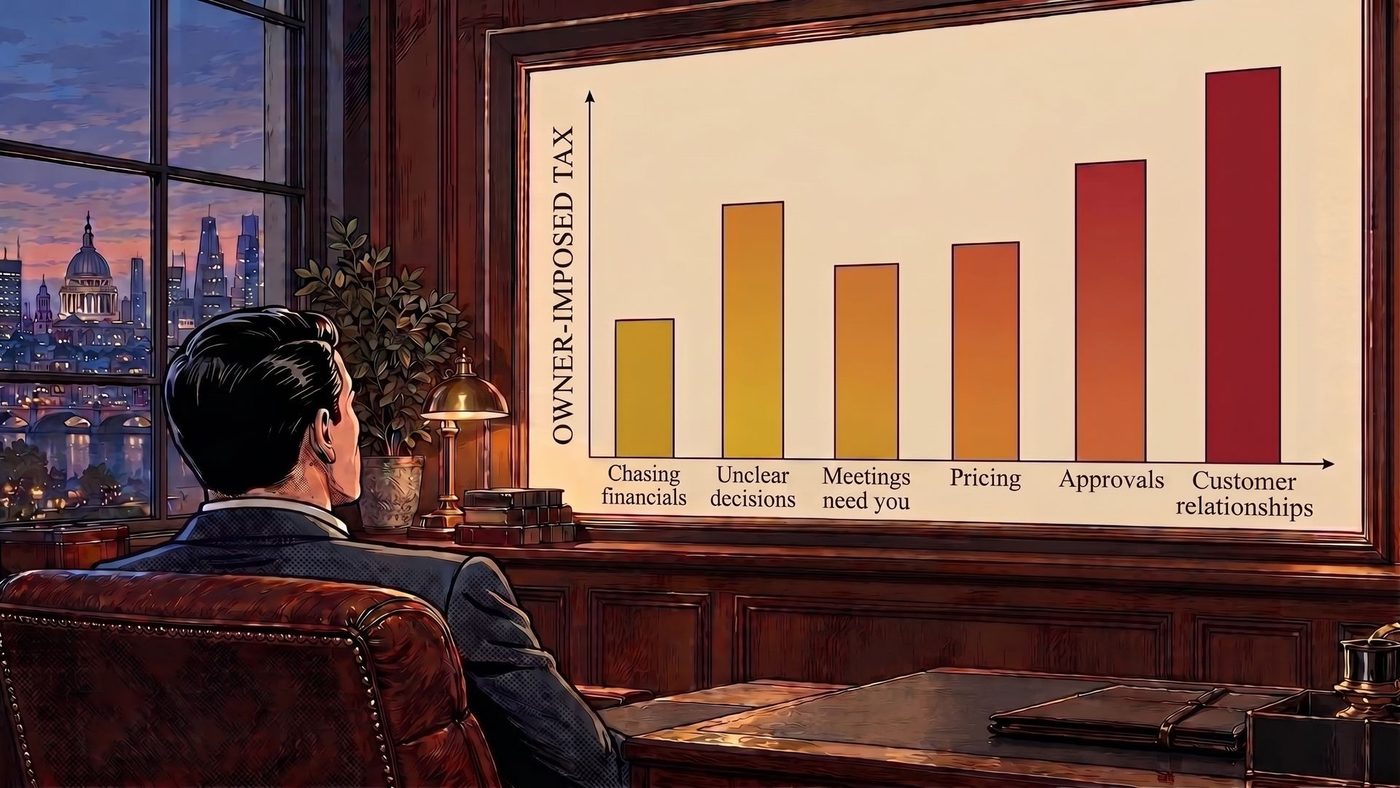
Be honest about where your answers point. In most of the owner-led businesses I work with, one person’s name comes up in all four answers. The step waiting for your reply. The approval only you can give. The meeting that can't happen without you. The decision nobody can predict until they've asked you.
The problem isn't that you've written too many rules. It's that the friction runs through you. That's the tax you're charging your own business.
People learn fast in a high-friction business. The capable ones stop suggesting improvements, because the suggestion just joins the queue. The ambitious ones leave for somewhere they can actually get things done. The ones who stay learn to wait. Growth slows to the pace of the slowest step.
None of this happened through bad intent. Every approval, meeting and process was added for a good reason, usually when the business was smaller and checking everything was how you kept quality high.
Better rules, not fewer
"If I don't check it, things go wrong."
Sometimes that's true. So don't remove the check - move it instead.
The best-run businesses I've seen don't have fewer rules than everyone else. Often they have more. The difference is where those rules live. A pricing guide that tells your sales team exactly what discount they can offer. An approval limit built into the system, so anything under it goes straight through. A weekly report that puts the numbers in front of you without anyone having to ask. A clear line on who decides what.
Rules like these don't slow anyone down. They give people the confidence to act because they know where the line is, and they keep you in control without putting you in the way.
A good rule runs in the background. A bad one runs through you.
Buyers will spot this instantly
When a buyer or investor looks at your business, they ask the question an investor asks about a country: how easy is it to get things done here? Then they add one more. Does that depend on one person?
A business where everything runs through the owner is a high-friction economy with a single point of failure. Take the owner away and nothing moves. Buyers don't pay a premium for that.
A business with clear processes, clear decision rights and systems that work behind the scenes is easy to take over. That's what transferability looks like in practice. The easier your business is to run without you, the more it's worth.
An easy next step
Don't try to fix the whole business this week. Just make one thing easier.
Pick one thing your business does every week: sending a quote, onboarding a client, approving a purchase, handling a complaint. Write down every step it goes through, every person who touches it and every point where it waits.
Then circle the step where it waits longest, and write one sentence on what would make it easier. A clear rule, a decision handed to the right person, a step removed or, even better, a system that does it automatically.
Somewhere on the chart there's a dot for your own business. Every bit of friction you remove will move it further towards the top right.
All the best,
Gavin
P.S. Removing business friction is where our 90-Day Sprint begins: we deal with the constraints holding back your next level of growth, then build the plan for what needs to happen. Start your 90-day sprint here.
Book a call to find out if your business is exitable