An experienced and competent buyer doesn’t see your business the same way you do.
You know exactly what it took to make your business a success. And you can also see the future potential of the business, with the right level of support.
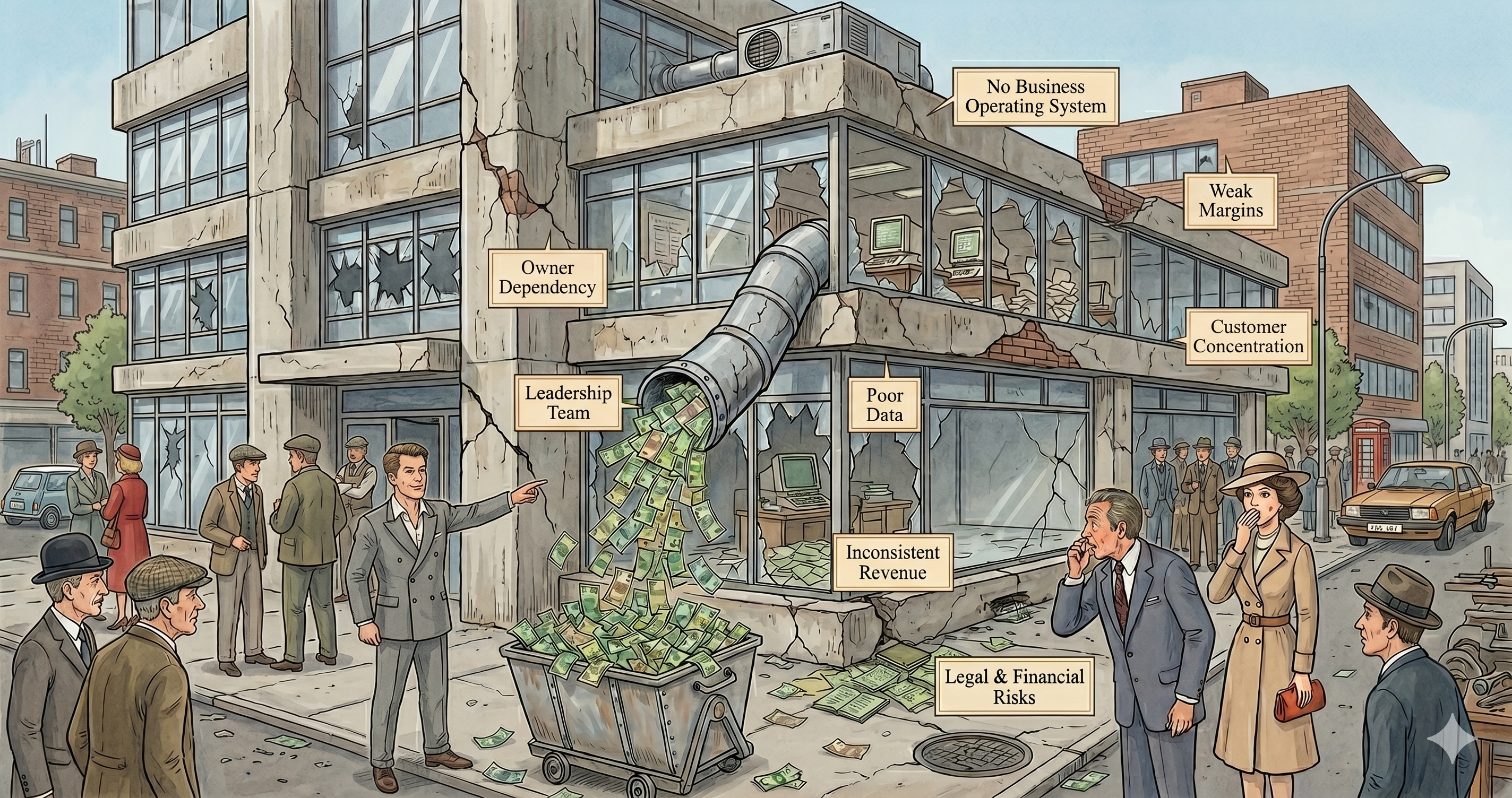
But serious buyers are looking at risk. They will work through a checklist of structural vulnerabilities - and adjust their valuation downwards for every one they find.
In my experience, most owner-led businesses have at least four of these risks showing up as problems for the owners. Not because the owners lack ability. But because these are the issues every growing business tends to accumulate when the focus is on running it, rather than on building it to maximise valuation.
Here are the valuation killers that matter most
1. Owner Dependency
Every key decision, every important relationship, every piece of knowledge about how this business actually works - it all runs through you. The business needs you there. To a buyer, that's not transferable value.
2. Leadership Team
One senior management layer - and with some people in the wrong places. No clear succession. Nobody who could confidently run the business and take it to the next level, if you stepped back tomorrow.
3. No Business Operating System
The business runs on personal knowledge and judgment. It works because of the people, not because of the system. That makes it hard to transfer, hard to scale, and hard to de-risk in due diligence.
4. Poor Data
Decisions get made on gut feel or last month's numbers. No real forward-looking view. No leading indicators. The rule around data is “Garbage in, garbage out” - and a buyer will spot it fast. They want to see a business that actually knows where it's heading.
5. Inconsistent Revenue
Good quarters, quiet quarters, no reliable pattern in between. You have a non-existent or unpredictable sales and marketing engine. Buyers will factor this uncertainty into their valuation of your business.
6. Customer Concentration
Too much revenue sitting with one customer, one channel, or one relationship. If that relationship changes - and eventually most do - so does the business. Buyers see it immediately and structure the deal to protect themselves.
7. Weak Margins
Pricing that's a bit loose. Costs that creep up. A profit line that exists but nobody's fully in control of it. Hard to defend in due diligence, and hard to grow without the cost base growing with it.
8. Legal & Financial Risks
Contracts that haven't been looked at in a while. IP that isn't properly protected. Compliance gaps. A finance function that produces annual accounts rather than real-time management insights. Buyers find these in the first hour of due diligence - and every one they find changes the conversation.
The question isn't whether you have some of these. Most businesses do.
The question is which ones, how serious, and what they are costing you in valuation terms and personal wealth-building right now.
Because the gap between a business that commands a premium and one that gets discounted is rarely about revenue. It's almost always about bottlenecks and structure.

If you want to know where the structural risks and bottlenecks are in your business and HOW to fix them, find out more about getting a simple bottleneck audit for your business.
If you want an honest picture of where your business stands against these valuation killers - and more - that's exactly what our bottleneck audit is built to do. We score you across each area, identify the quick wins and the structural issues, and build a clear plan for closing the gap.
All the best,
Gavin
P.S. If you're interested to know how much money you're leaving on the table - and how you can create a growing business that runs without you - let's have a conversation: Schedule a 30-minute strategy call

Thinking About Exiting Your Business?
You've built something worth selling. The real question is whether it's built in a way that gets you the price you want. Buyers don't just look at the numbers. They look at how much the business still depends on you, whether the growth is something they can repeat, whether the team can run things without you - and whether the whole business is genuinely transferable.
Book a complimentary strategy call (click here) to see what may be holding back your exit value.