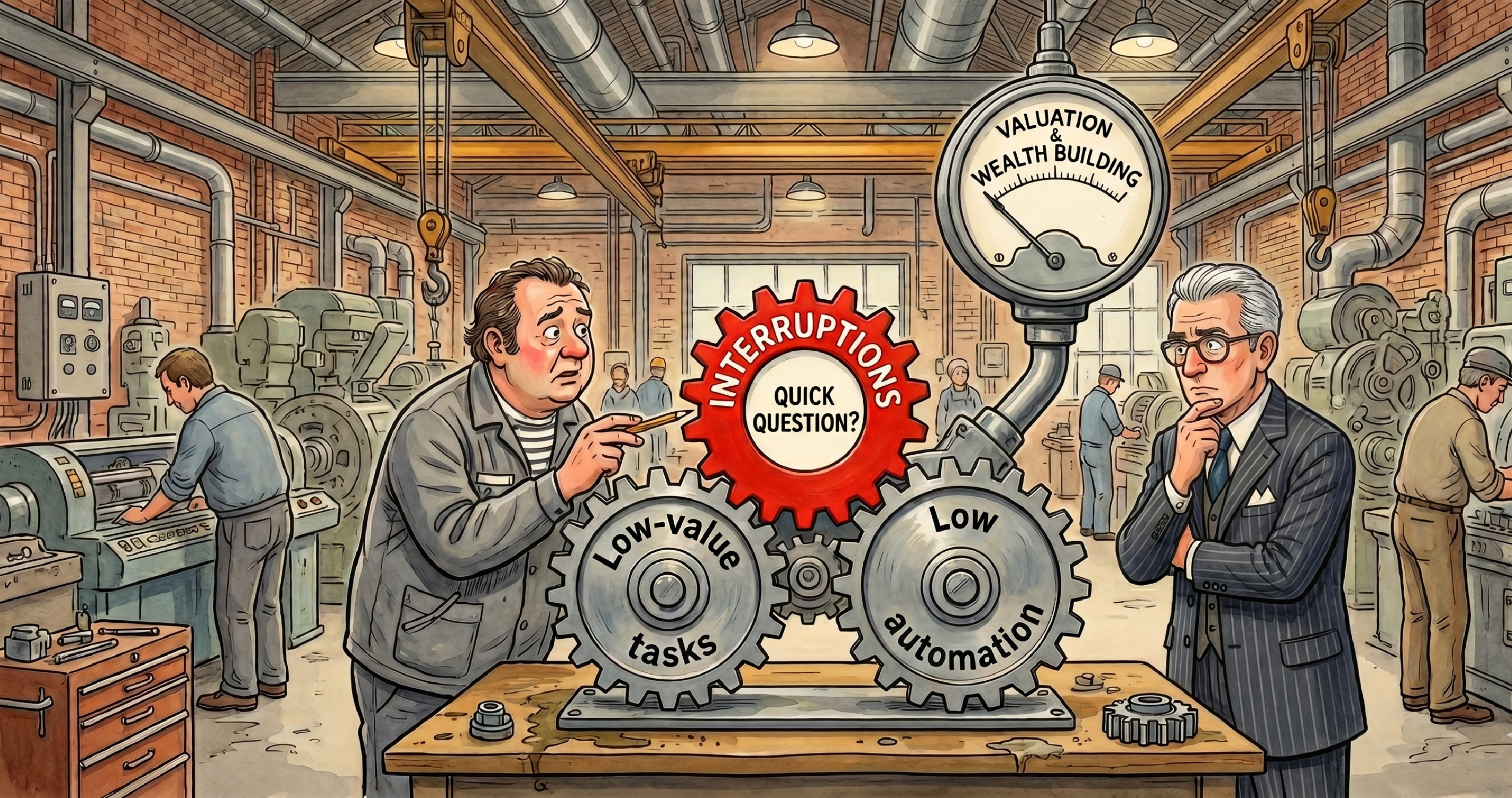
The visible cost of owner-dependency in your business is YOU doing low-value tasks.
But the invisible cost is far larger: every interruption destroys your flow, which destroys your strategic focus, which destroys your ability to build wealth through increasing company valuation. It's a wealth tax - compounding daily into millions in unrealised value.
You pay a hidden Wealth Tax for each "quick” question
There's a pattern I see in almost every owner-led business I work with.
The owner is capable and experienced. The team is competent. Revenue is solid. On paper, everything works.
But when we map how their week actually unfolds, something becomes obvious. Their attention isn't theirs. They’ve become a bottleneck. Their most valuable asset - the ability to think strategically about growth, positioning, and long-term value - is being taxed at source.
"Can I just grab you for two minutes?"
"Quick question before I send this."
"I didn't want to decide without checking with you first."
Each one feels harmless. Each one extracts a cost far greater than the time it takes.
What you don't always see…
Here's where it gets interesting.
A five-minute interruption doesn't cost five minutes. Research suggests it takes twenty-three minutes to return to deep work after a context switch. For strategic thinking - the kind that identifies new opportunities or spots what's suppressing value - the recovery is often longer.
So when someone pops in with a quick question, they're not borrowing five minutes. They're borrowing forty-five.
But the real cost goes further. Interruptions break flow. Broken flow prevents strategic focus. And strategic focus is the only thing that moves the needle on valuation and your personal wealth creation.
The owner who never gets unbroken time to think about growth, positioning, or structural improvement isn't just tired. They're paying a wealth tax.
If this happens six times a day, you're not losing thirty minutes. You're losing an entire working day of strategic capacity. The growth that wasn't pursued, the inefficiency that wasn't spotted, the opportunity that wasn't developed - none of it shows up on any report. But it shows up in the gap between what the business is worth and what it could be worth.
That gap, compounded over years, is where your wealth lives. Or doesn't.
If you want to know where the bottlenecks are in your business and HOW to fix them, find out more about getting a simple bottleneck audit for your business.
Why teams escalate (it's not incompetence)
Escalation isn't usually a people problem. It's a systems problem.
Teams escalate when decision rights are unclear. When there's no documented framework for "how we handle this." When the criteria for a good decision haven't been made explicit. When there's no permission structure that says: you can act here, within these boundaries, without checking upward.
They also escalate when they lack confidence - not in their judgment, but in whether their judgment will be supported. If checking with the owner is always safe, they will always check.
The business owner becomes the workaround for infrastructure that doesn't exist.
Increasingly, teams that don’t have access to the information, context, or AI-assisted tools that would let them answer their own questions…. will simply escalate because there's no system that helps them find out without asking you.
The opportunity cost
We all know that business acquirers reduce their valuations for owner-dependency.
But the more immediate cost isn't what a future buyer will subtract. It's what you're not building right now.
What's the difference between the business you're running and the business you could build with twenty hours of uninterrupted strategic time each week?
With that time, you might identify the inefficiency costing 12% of margin. Develop the partnership that opens a new revenue stream. Build the leadership layer that lets the business scale beyond your bandwidth. Spot the acquisition that doubles your footprint.
Without that time, none of it happens. Not because you're not capable. Because you're never in a position to think about it properly.
The infrastructure that sets you free
This is all about building decision-making infrastructure that removes you as an operational gatekeeper - and remaining as a bottleneck.
The infrastructure has three layers.
First: documented systems and processes. Living documentation that answers questions before they're asked. Every recurring interruption is a symptom of a system that wasn't built.
Second: decision frameworks with explicit permission. Your team needs to know not just what they can decide, but how to decide it well. What trade-offs are acceptable? What does good judgment look like? When those things are explicit, people act. When they're implicit, they defer.
Third: AI-assisted intelligence. Tools that surface answers, provide context, flag exceptions, and route only genuine strategic decisions to you. Not to replace your team, but to give them what they need to act without asking. The technology exists. Most business owners haven't built it into their operating model.
The prescription
For the next five days, track every interruption. What questions keep recurring? What decisions keep landing on your desk that shouldn't require you? What's missing - system, framework, or intelligence - that would let it happen without you?
Then build the asset that makes it happen.
The owner who builds this capability doesn't just create a more valuable company. They stop paying the wealth tax that's been compounding against them for years.
All the best,
Gavin
P.S. If you're interested to know how much “wealth tax” you're paying - or how you can create a business that runs without you - let's have a conversation: Schedule a 30-minute strategy call
Know another business owner wrestling with a company that doesn’t run without them? Please forward this to them.
Thinking About Exiting Your Business?
You’ve built a valuable business. Now the question is whether it can deliver the exit you want. A buyer is not just looking at your revenue or profit. They’re looking at how much of the business still depends on you, whether growth is repeatable, whether the team can operate without you, and whether the business is truly ready to change hands.
Book a complimentary strategy call (click here) to see what may be holding back your exit value.