There are 5.7 million private businesses in the UK.
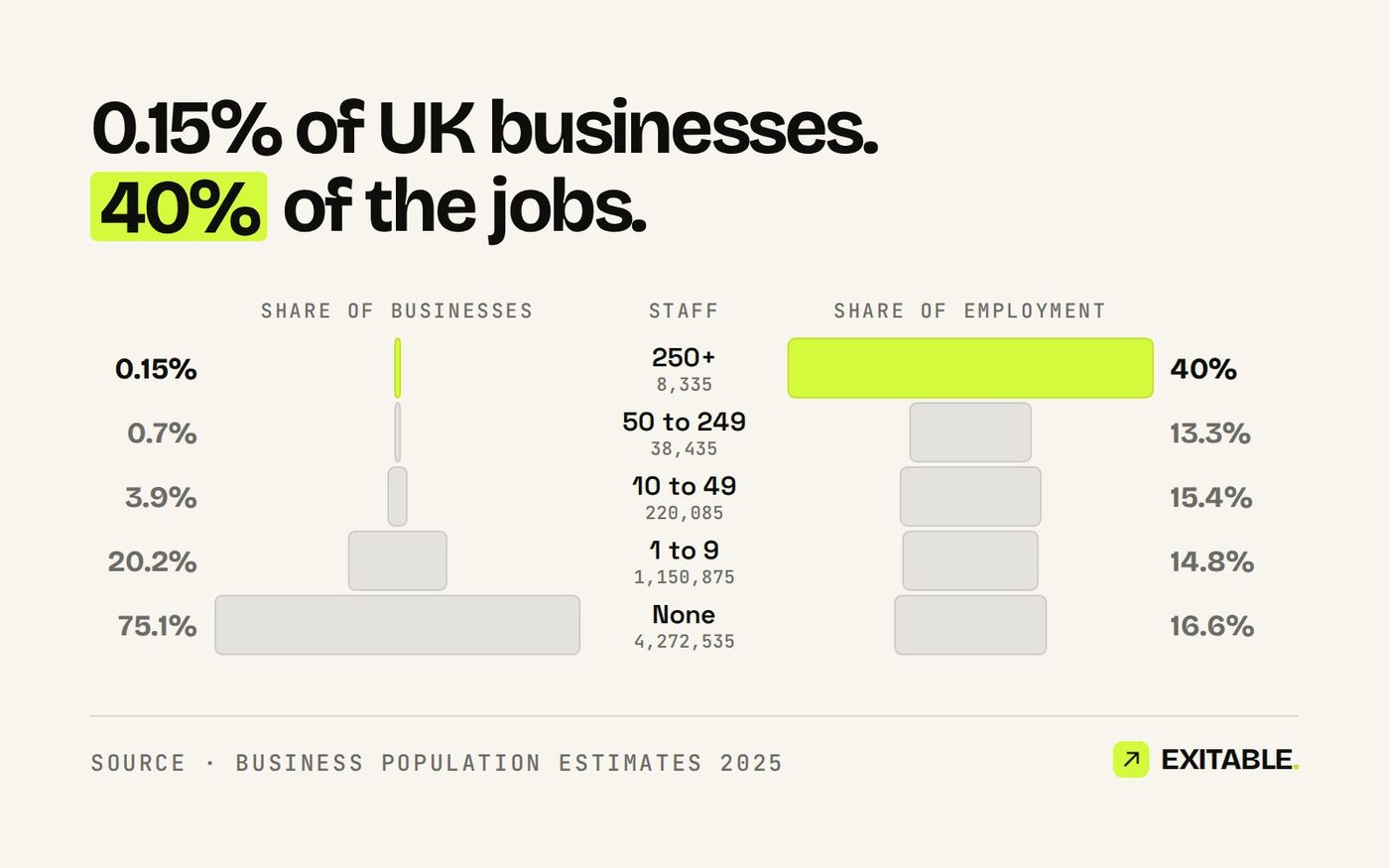
Fewer than 8,500 of them employ more than 250 people. That's roughly 0.15 percent of all UK businesses.
And that tiny group employs 40 percent of the country's workforce and generates half of its private sector turnover.
I've been thinking about that number for a couple of weeks now, because it points towards something that nobody seems to talk about.
250 employees is not a size of business - it's a class of business. What I really mean is that there’s a different set of buyers and a different set of rules for companies of this scale - and a great deal more money on the other side of the dividing line.
And yet that line is probably closer than you think.
What the numbers actually mean
The exact figure of 8,335 comes from the government's own business population estimates. Underneath it, roughly 38,000 businesses in the whole country are in the 50 to 249 employee band.
So using headcount as a metric, the UK economy is not a pyramid with a gentle slope - it’s more of a drawing pin. It’s millions of small businesses, a thin layer of medium ones and a few thousand at the top holding half of everything.
Why this matters to you relates to “who” is looking at you from an acquisition standpoint.
When a business crosses the 250 level, that makes it more visible to a category of buyer and investor that doesn’t look below the line at all.
Is headcount the only yardstick? Of course not. It's just one of several markers. But it just so happens that institutional money is taking an increasing interest in companies of this size. I’m talking about pension funds, the larger private equity houses and the lenders that JPMorgan and others are now pushing into the mid-market.
Why companies of your size don’t think about it
"That's not us. We're a good business, but we're not corporate."
I've heard that sentiment expressed plenty of times and I understand it. If you run a business with 30 people and you grow at a very respectable 10 percent each year, the arithmetic says you'll reach 250 people organically in about 23 years.
OK, I know that’s arithmetic and not the real world. But the point is - becoming a much larger company takes time - and it’s often more time than you realistically have to make such a big impact.
So the 250 mark gets quietly filed under "not for people like me", and the owner gets on with running the business in front of them.
That isn't a failure of ambition, it’s just that organic year-on-year growth was never going to get them there.
What’s changed in the last couple of years?
A couple of things are different now. The first is money. Institutional capital used to stop well above most company owners’ heads. Like I said, JPMorgan and others are now pushing hard into mid-market private credit and direct lending and a good deal of that money is looking for one thing: groups that have crossed, or are about to cross, the 250-person line. There are fewer than 8,500 of those, but that institutional money would like there to be more.
The second is that the people building those groups are increasingly not private equity houses. They’re business owners. People who simply worked out that their competitors, or the businesses in their supply chain, or companies in adjacent industries - were actually building blocks to create much more value and wealth.
Someone is going to assemble these businesses in your sector into a group. The only question is whether that someone is you.
The building blocks are all around you
Take a moment and think about your own market. The competitor you respect but rarely beat on price. The two firms in the next county doing what you do for a slightly different customer. The business in an adjacent trade that shares your clients, your suppliers or your site visits but sells something you don't.
Building a group of companies gets you closer to the next threshold, whether that's revenue, EBITDA or headcount.
You don't need to acquire or partner with other companies all at once and you don't need to go for the biggest. What you need is a clear picture of the group you're building: what it does, who it serves, why the parts are worth more together than apart.
An acquisition can achieve more in 12 months than organic growth can in 5 years. And several acquisitions or partnerships can do what organic growth would never do at all.
"This is a private equity play, it’s not for me"
You're right that PE does this already. But PE pays professionals to find the same few businesses that you could name off the top of your head - and it pays them a lot. You already know your sector, your customers and the owners across the table. That’s a big advantage.
Other business owners in the £5M-£75M turnover range are already doing this right now. They are not better funded than you; they just spotted what was going on around them and decided they wanted to be on the right side of this opportunity.
Your next step
Don't do anything big this week. Do one small, specific thing.
Write down the 5-6 businesses you would want in your group. Competitors, adjacent trades, the firm you've always thought you could run better than its current owner does. Next to each one, write a single sentence on why it belongs.
That list is the start of a group-building strategy. It's also the moment the 250 mark stops being arithmetic and becomes a plan.
All the best,
Gavin
P.S. If the list is the easy part and the next move is the hard part, that's the conversation I have with owners every day. Book a call with me here and bring your list.

Book a call with me to find out more…