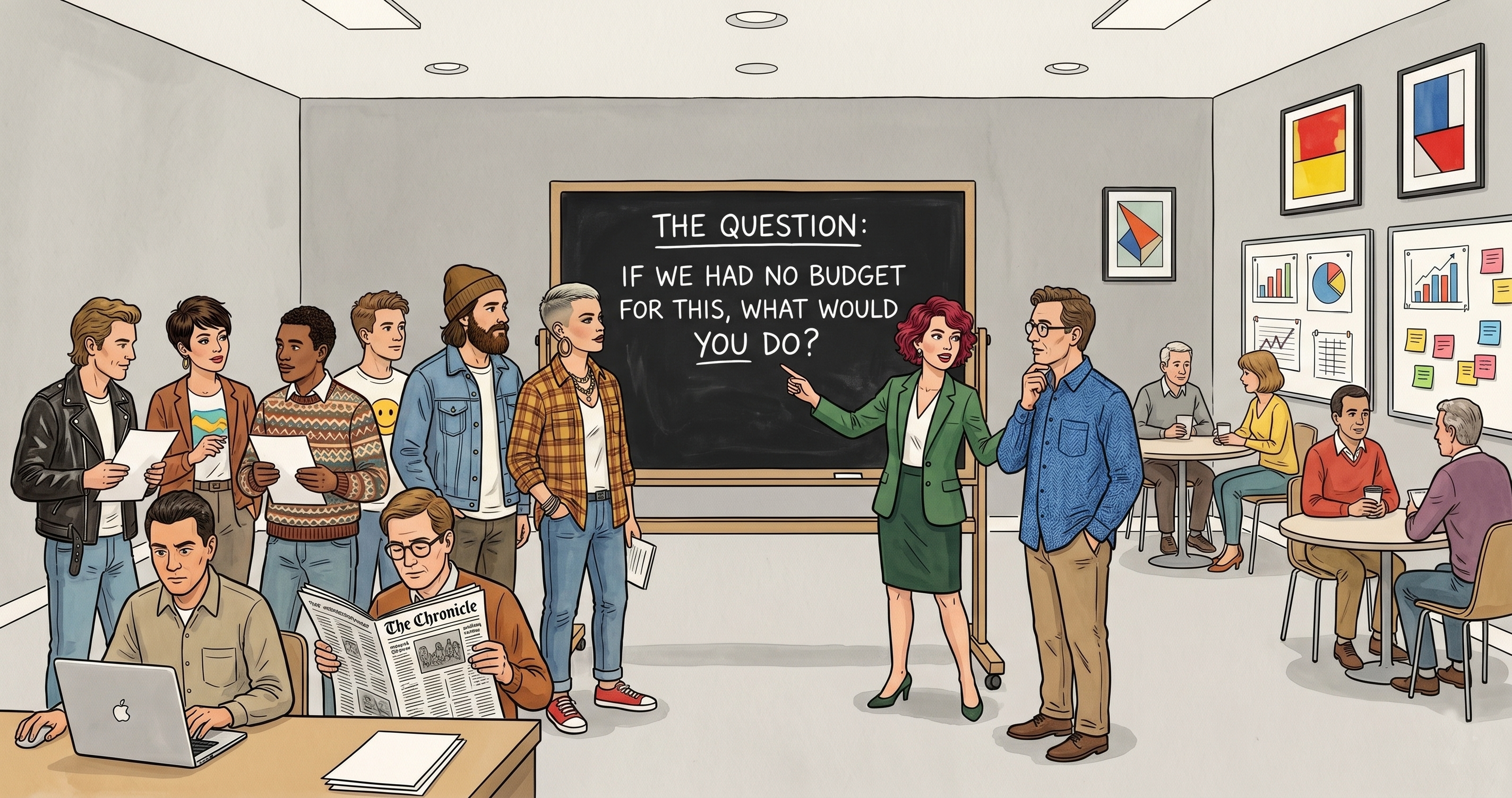
The quality of your leadership team becomes brutally clear the moment you remove the ability to throw money at a problem. Most owners discover too late that their team was trained to spend, not solve. Real capability emerges when you engineer intelligent trade-offs, rather than assign a budget.
When budget becomes a safety net
Give a weak team £50,000 and a challenge, and they'll return with a vendor proposal, a new hire request, or a technology purchase. Give a strong team the same challenge with no budget, and they'll return with a redesigned process, a repurposed resource, or an automation that costs nothing but thinking time.
Sometimes going back to “first principles” and challenging basic assumptions is what's needed. Don't get me wrong - of course it’s possible that capex/opex may still be required, but a smart team might find a way to convert a cost into profit centre.
This shows up everywhere
It shows up when your marketing person wants help from an agency, before testing the messaging themselves. It shows up when your Ops director wants another body instead of automating the process so the existing team can execute it. It shows up when the team requests enterprise software instead of prototyping the workflow in a low-code tool first.
This isn't a cost control issue. It's a value creation issue.
Business buyers and investors are expert at assessing leadership teams. They're not just looking at revenue delivery or client relationships. They're also looking at resourcefulness. They're analysing whether your team solves problems or just escalates spending requests. And when they see a leadership structure that defaults to external spend rather than internal ingenuity, they price that dependency into the valuation.
The constraint that builds capability
The businesses that run without the founder, that scale efficiently, that command premium multiples - they all have one thing in common: leadership teams that were forced, early and often, to solve problems with intelligence rather than budget.
That is deliberate. It's not about being cheap. It's about building a team that thinks strategically, that understands trade-offs, that can differentiate between a structural problem that needs investment and a capability gap that needs redesign.
It's hardly surprising that the most valuable businesses aren't the ones that spent the most. They're the ones that thought the hardest about where to spend, what to build internally, and how to get more leverage from what they already had.
It’s not about asking questions to avoid spending
This doesn't mean starving your business of investment - and it doesn't mean procrastinating on the decision. It means changing the question.
Instead of "What will this cost?" the first question becomes "Could we solve this without spending?" Instead of "Who should we hire?" it becomes "Could we redesign the workflow so the existing team has capacity?" Instead of "Which vendor should we use?" it becomes "Could we build this ourselves in a way that's transferable and gives us more control?"
The teams that can answer those questions well, that can show their work, that can demonstrate they explored the zero-cost and low-cost options before recommending investment - those are the teams that add value. The ones that can't are just adding overhead.
Test it now
Most founders discover this gap when a buyer asks pointed questions in due diligence about why certain costs exist, or when cash flow tightens and they suddenly realize the team has no muscle memory for operating lean.
You don't have to wait for that moment. You can test it now.
Take the next three problems your leadership team brings you. Before approving any spend, ask one question: "If we had no budget for this, what would you do?"
The quality of the answers will tell you everything you need to know about whether you've built a team that thinks or a team that spends.
And if the answer is uncomfortable, that's not a leadership problem. That's a training problem. Which means it can be fixed.
All the best,
Gavin
P.S. Wonder how transferable your business actually is?
Most owners believe their leadership team is capable. The real question is whether they're capable of running the business without you in the room, making decisions with intelligence rather than budget.
Share this with a founder whose team defaults to spending rather than solving.

Thinking About Exiting Your Business?
A strong business doesn't automatically mean a strong exit. Buyers dig deeper than your top and bottom line. They're asking how much of the company lives in your head, whether the growth is dependable rather than lumpy, whether the team can operate without you driving, and whether the business is truly built to last.
Book a complimentary strategy call (click here) to see how you can dramatically improve your business and increase its valuation.