Here's a question worth 10 minutes of your week.
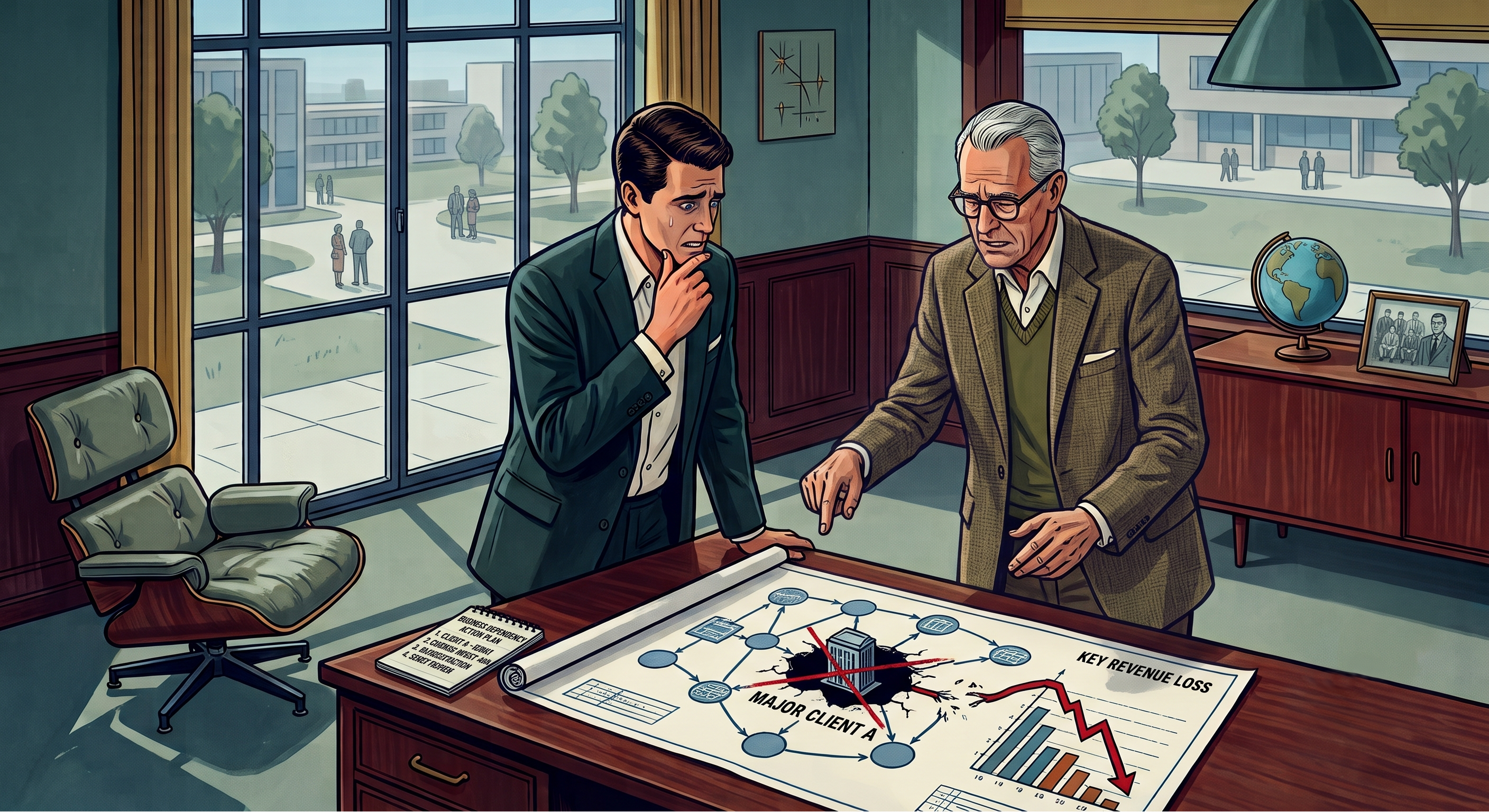
Pick the biggest client on your books. The one whose name comes up in every forecast conversation. Now ask, honestly - what happens if they're gone tomorrow?
Not "gone eventually", with a long handover and time to replace the revenue. Gone tomorrow. Contract ended, budget pulled, relationship moved on with a decision-maker who left.
If the honest answer is "we'd be in serious trouble", you've just been reminded of something important about your business. Not a hypothetical risk to file away - a real risk with a number attached, which impacts what your business is worth.
And here's the uncomfortable part: you can go years without ever running that test on your own business. Well, a buyer runs it in the first hour.
What else could be gone tomorrow?
Before we go further, let's be clear about something: none of this is unusual in business.
The client who's grown to a third of your turnover? You won that work, kept them happy, and they kept coming back. That's not a mistake - that's good service compounding.
The operations lead who holds half the business in their head? You promoted them because they were excellent, and they got better every year.
The pipeline that still runs on your personal relationships? That's how businesses like yours grow. It worked, so you kept doing it.
Every dependency in your business was a sensible decision at the time. That's exactly why they're dangerous - they don't arrive looking like risk. They accumulate quietly, one reasonable yes at a time, until the business isn't held up by structure. It's held up by nothing going wrong.
The full test
The question works on more than your biggest client. Run it 5 times:
Your biggest client. Gone tomorrow - how much revenue walks out with them, and how fast could you replace it?
Your best person. Resignation letter on your desk Monday morning. What leaves with them that isn't written down anywhere - and able to be transferred to someone else?
Your main source of new business. The channel, the referral network, the relationships that fill the pipeline. If it dried up this quarter, what happens next?
Your most critical supplier or system. The one everything routes through. If it failed, how long before your clients felt it?
You. Step back for three months - genuinely stepping back, phone off. What still moves, and what stops dead?
Grade each answer honestly: we'd barely notice, we'd wobble but recover, or we'd be in serious trouble.
Most owners skip the last question. It's usually the worst answer on the page.
What a buyer does with your answers
At Exitable and through my work with Synergy Groups - I've sat on both sides of the table - and I can tell you the questions a buyer asks about your business are not the ones you ask about it.
You look at revenue, profit, pipeline, the order book. A buyer looks for single points of failure. Buyers don't pay a premium for revenue. They pay a premium for transferability and resilience - for a business that can take a hit and keep running.
So every "we'd be in serious trouble" on your list becomes something concrete on theirs: a discount on the multiple, an earn-out that keeps you locked in for years, or a deal that quietly goes away.
You might thinking - I'm not selling, so this doesn't apply to me.
It applies more than you'd like. The discount doesn't wait politely for a sale process to start. Those weaknesses are shaping your options right now. A business that can't afford to lose its biggest client can't push back on that client's payment terms either. A business that depends on one person can't restructure around them. Every unmanaged dependency is a negotiation you can't win - with clients, with staff, with buyers, with anyone who works out where the weight sits.
The good news: “suppressed” doesn't mean “lost”
Here's the part that matters most. Value doesn't just disappear - it gets suppressed. And suppression is fixable.
Every bad answer on your list is a known problem with a known fix. Client concentration comes down through deliberate business development, not luck. Knowledge trapped in one person's head gets documented, systemised and shared. A pipeline built on the owner's relationships gets rebuilt as a channel the business owns. Founder dependency reduces the same way it was built - one decision at a time, in the other direction.
You don't fix all 5 at once. You find the worst answer on the page and start there.
So here's the one thing to do this week: take 10 minutes, run the test, and write the 5 answers down. In writing, unfiltered. Not because the answers will be comfortable - but because you'd rather read them years before a buyer does than the week after.
The test costs nothing, and most owners never run it. The ones who do - early, honestly, and while there's time to act on it - are the ones who end up choosing their own outcome instead of accepting one from someone else.
All the best,
Gavin
P.S. If you run the test and don't like what you see, that's a better outcome than not running it at all. This is exactly what our business audit is built for - a structured look at what's suppressing your valuation and, more importantly, what to fix first. If you want an outside perspective on your 5 answers, just reply to this email.
If you know another business owner who’d benefit from reading this newsletter - please share it with them.
For construction and building services companies - see how your business can win more work and waste less time - Visit McGideon.